Choosing the Best Stock Market API: A Practical Review of Data Providers


Most stock API reviews compare the obvious things: pricing, endpoint count, documentation, rate limits, and supported markets.
Those details matter, but they do not answer the bigger question: Can this API support the workflow you are actually building?
A backtesting engine needs clean adjusted price history. A dashboard needs fresh and reliable quotes. A screener needs fundamentals and company metadata. An AI assistant needs structured responses it can retrieve and reason through cleanly.
That is why choosing a stock market API should start with the project, not the provider’s feature list.
This article looks at stock APIs from that angle. The goal is not to find one perfect API for every situation, but to understand which provider fits each real workflow best.
What Traders and Developers Should Actually Compare
Once the workflow is clear, the comparison becomes more practical. These are the factors that actually matter when choosing a stock market API.
Market and Asset Coverage
Coverage is not just about having a large symbol list.
A simple US stock dashboard may only need equities and ETFs. A global backtester may need international exchanges, indices, forex, and corporate actions. An options workflow needs chains, strikes, expiries, Greeks, and implied volatility. An AI assistant may need a mix of prices, fundamentals, macro data, and company metadata.
The right coverage depends on how wide your product or research workflow needs to go.
Data Quality and Production Reliability
Market data issues are not always obvious.
A missing dividend adjustment, incorrect split handling, stale symbol, or inconsistent field can quietly distort a chart, backtest, or model. This matters even more when the data is used inside a product that users depend on.
Good data should be consistent, adjusted where needed, and reliable enough to support repeated use across dashboards, models, screeners, and production systems.
Historical Depth and Real-Time Access
Not every project needs the same data freshness.
Backtesting usually needs long, clean historical data. Dashboards may need delayed or real-time quotes. Trading-related tools may need intraday data, fast updates, or low-latency feeds.
It helps to separate these clearly:
End-of-day data works for long-term research and reporting.
Intraday data works for shorter-term analysis and dashboards.
Real-time or low-latency data matters when users need live market movement.
The best API for a backtester may not be the best API for a live alert system.
Fundamentals and Company Data
Price data tells you what happened. Fundamentals help explain the business behind the price.
If you are building a screener, valuation tool, or research dashboard, you need more than OHLCV data. Financial statements, earnings, ratios, company profiles, and metadata become important.
This is also useful for AI workflows. A research assistant that can combine price movement with revenue, margins, cash flow, and earnings context will produce better answers than one that only sees stock prices.
Licensing and Commercial Use
Licensing is easy to ignore during a prototype, but it matters once the data is used in a product.
Using market data in a private notebook is different from showing it inside a public dashboard, broker tool, or paid fintech app. Teams need to understand whether the data can be displayed, redistributed, stored, or used commercially.
This does not mean every developer needs to become a licensing expert. But before building on top of any provider, the commercial use case should be clear.
AI Workflow Fit
A good API should be easy to build with after the first successful request.
Documentation, response structure, SDKs, examples, error handling, spreadsheet access, and rate-limit clarity all affect development speed. Clean responses also reduce parsing work and make the data easier to use in Python, dashboards, and internal tools.
AI readiness is becoming part of this same evaluation. As financial data moves into copilots, LLM tools, and agent workflows, APIs need to return structured and predictable data. MCP support, tool compatibility, and clean schemas can make a big difference when the API becomes part of an AI system’s reasoning loop.
Quick Provider Snapshot
Before going deeper into each provider, here is a quick snapshot of where each API fits best.
This is not the full evaluation. It is just a simple way to understand the market before looking at the details.
Provider | Strongest Fit | Main Strength | Main Tradeoff |
Alpha Vantage | Broad conventional and AI-native workflows | Coverage, fundamentals, indicators, MCP | Not for nanosecond-level co-located systems |
Xignite | Enterprise financial applications | Enterprise catalog and support | Less self-serve for smaller teams |
EODHD | Global historical coverage | Long EOD history across many markets | More exchange-specific handling for global workflows |
Intrinio | US fundamentals and professional data | Standardized financials and research datasets | Requires more upfront dataset evaluation |
Tiingo | Clean stock and ETF price data | Simple API and clean price workflows | Less suited for enterprise redistribution |
Bloomberg API | Existing Bloomberg institutions | Deep institutional data | Expensive and complex for most developers |
This table gives the high-level view. Now let’s look at each provider through the workflow lens: where it fits, why it matters, where to be careful, and what kind of user it makes the most sense for.
Comparing the Providers Through a Workflow Lens
At this point, the comparison becomes easier.
Instead of asking which API is “best” in a general sense, it is better to ask where each provider actually fits. Some are built for enterprise financial applications. Some are stronger for historical research. Some are better for clean fundamentals. Some are more useful when the workflow includes AI agents or natural-language tools.
So I’ll go through each provider with four simple questions:
Where does it fit?
Why does that matter?
Where should teams be careful?
What is my practical take?
This keeps the comparison tied to real workflows instead of turning it into another feature-count ranking.
1. Alpha Vantage: Best Overall Market Data Infrastructure for Conventional and AI Workflows

Where it fits:
Alpha Vantage is one of the most balanced solutions for a wide range of use cases.
A lot of teams start with a simple requirement: daily stock prices, maybe intraday candles, maybe a few technical indicators. But that usually changes once the product grows. A dashboard may later need fundamentals. A screener may need earnings data. A research tool may need macro indicators. An AI assistant may need structured access to several datasets at once.
This is where Alpha Vantage works well. Its breadth of coverage spans major asset and data categories, including equities, ETFs, mutual funds, indices, forex, crypto, commodities, fundamentals, technical indicators, and market intelligence datasets. It also covers 20+ global exchanges across North America, Europe, and the Asia Pacific, which makes it useful for teams that do not want to stay limited to one market or one asset class.
It also supports spreadsheet workflows and MCP access for AI agents, so it is not limited to one type of user. For developers, fintech teams, researchers, and AI builders, that broader coverage makes Alpha Vantage a practical starting point before adding more specialized vendors.
Why it matters:
The biggest strength here is versatility.
You are not forced to treat market data, fundamentals, technical indicators, and AI access as separate problems from day one. For developers and fintech teams, that reduces integration friction. For researchers, it creates more room to combine price action with business data. For AI builders, it gives agents a cleaner way to retrieve financial data instead of relying on static knowledge or custom wrappers.
The data quality angle is also important. Alpha Vantage sources data through official exchange relationships, including Nasdaq-licensed US market data. That matters in production because the question is not just whether an API returns a number. The question is whether the data is licensed, structured, and reliable enough to support a real product.
This is also why the MCP piece matters. Tools like Claude, Cursor, VS Code, and other agentic environments are changing how developers interact with APIs. Instead of manually wiring every request into a Python script or backend service, the model can call a structured tool and reason over the result.
That does not replace good engineering, but it changes the starting point.
Where to be careful:
Alpha Vantage is not meant to solve every market data problem.
If you are building a nanosecond-level trading system or anything that depends on co-located exchange infrastructure, you should be looking at dedicated exchange feeds and specialized infrastructure. That is a different category of problem.
My take:
Alpha Vantage is the strongest overall solution in this comparison for teams building across conventional market data workflows, fintech applications, and agentic AI systems.
If the project needs prices, fundamentals, indicators, spreadsheet access, and AI workflow support from one provider, it is one of the more practical options to evaluate. It is not the answer to every edge case, but for a wide range of enterprise data needs and AI-driven workflows, it empowers teams to get the job done with a unified API.
2. Xignite: Enterprise Financial Data Delivery

Where it fits:
Xignite fits best when the buyer is not just a developer testing an endpoint, but a financial business building a production application.
Think banks, brokerages, wealth platforms, robo-advisors, and larger fintech products. These teams usually care about more than the API response. They care about support, vendor stability, service expectations, data coverage, and whether the provider can fit into an enterprise environment.
That is the lane where Xignite makes sense.
Why it matters:
Xignite has a broad enterprise data catalog across market data, reference data, fundamentals, corporate actions, currencies, fixed income, commodities, and other financial datasets.
For a serious financial product, that breadth matters because the data requirements usually expand. A wealth platform may start with stock quotes, but later need corporate actions, fund data, reference data, or fixed-income datasets. Having a provider built around enterprise delivery can reduce some of that vendor fragmentation.
There is also a practical reliability angle here. Once market data is powering a user-facing financial product, uptime, support, and service-level expectations become part of the decision. These things are not exciting, but they matter when real users depend on the application.
Where to be careful:
Xignite may feel heavy if the goal is quick experimentation.
A solo developer, early-stage startup, or AI builder may not want an enterprise-style buying process before testing an idea. It is not the most natural fit if you want to plug in an API quickly, test a few endpoints, and build a prototype over a weekend.
It also does not have the same AI-native positioning as newer MCP-supported workflows. You can still use Xignite data inside AI systems, but that is not its clearest angle.
My take:
Xignite is a serious option for enterprise financial applications.
I would not put it first for small developer projects or agent-first workflows. But if the product is already operating in a financial institution, or if the team needs broad data coverage with enterprise support behind it, Xignite has a clear role.
3. EOD Historical Data: Global Historical Coverage and Research Workflows

Where it fits:
EOD Historical Data fits best when the workflow needs broad historical coverage across global markets.
This is useful for backtesting, screening, long-horizon research, and market analysis that cannot stay limited to a few US tickers. If you are testing a strategy across regions, building a global screener, or studying how different markets behave over time, the depth and spread of the dataset matters a lot.
EODHD publicly highlights broad exchange coverage, 150,000+ tickers, and 30+ years of historical data. That makes it a strong fit for research-heavy workflows where the goal is to work across markets and time periods, not just pull the latest quote.
Why it matters:
The value of EODHD is not just that it has a large amount of data. It is that the data is useful for workflows that depend on history.
Backtests need enough historical depth to avoid overfitting to recent market conditions. Screeners need broad symbol coverage. Research tools need supporting datasets like fundamentals, splits, dividends, and technical indicators. EODHD is built around that kind of use case.
It has also expanded beyond traditional end-of-day data. WebSocket access gives it more relevance for real-time use cases, and its MCP support makes it easier to connect EODHD data into AI-assisted research workflows.
That gives it a wider role than just being a historical data provider, while still keeping historical coverage as its strongest lane.
Where to be careful:
The tradeoff with global coverage is not that the API is difficult to use. The bigger issue is the nature of global data itself.
Once you work across many exchanges, you need to handle different symbols, currencies, trading calendars, holidays, time zones, and exchange-specific conventions. Even with clean API responses, the workflow may still require more normalization than a US-only project.
That is something teams should plan for if they are building global products or research systems.
My take:
EODHD makes the most sense when historical depth and global reach are the priority.
It is a strong option for backtesting, global market screening, long-term research, and AI-assisted analysis that needs broad market context. Its real-time and MCP features add flexibility, but its clearest strength is still global historical coverage.
4. Intrinio: Standardized US Fundamentals and Professional Market Data
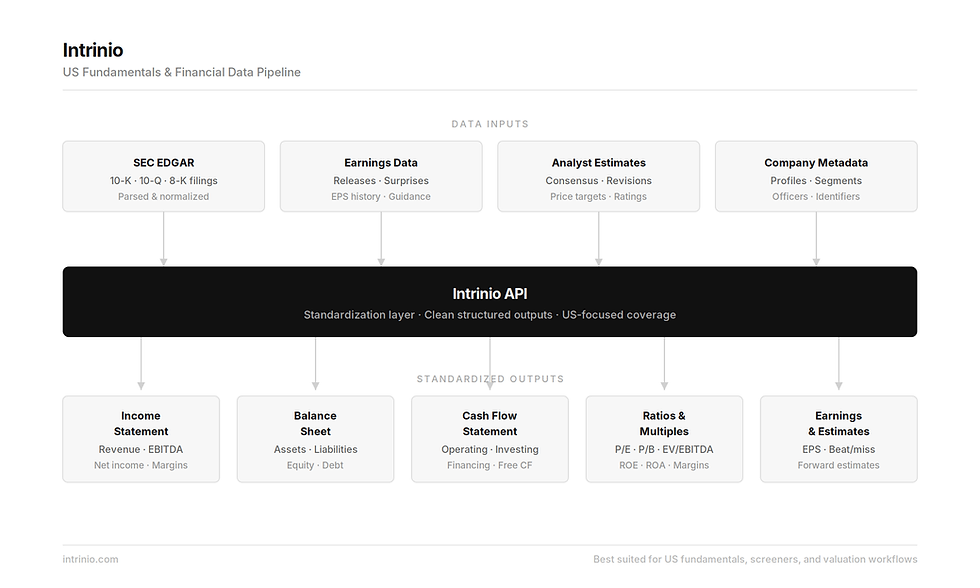
Where it fits:
Intrinio fits well when the workflow depends on clean company-level data.
This includes valuation tools, earnings dashboards, fundamentals-based screeners, options analytics, and US equity research products. If the product needs to compare companies across revenue, margins, cash flow, debt, earnings, or other metrics, standardized data becomes important very quickly.
Why it matters:
The main value of Intrinio is not just access to financial statements. It is the standardization layer around those statements.
Raw company filings can be messy. Line items differ across companies, reporting periods do not always align cleanly, and a lot of time can disappear into data cleanup before any real analysis happens.
Intrinio is useful for teams that want financial statements, company metrics, earnings data, and related professional datasets in a more research-ready format. Its options coverage also adds depth for teams building derivatives or volatility-focused tools.
Where to be careful:
Intrinio may require more upfront evaluation than simpler self-serve APIs.
Teams need to understand which datasets they need, how access is structured, what pricing applies, and what licensing terms fit their use case. That is not necessarily a weakness, but it means the buying process may be more involved.
My take:
Intrinio is strongest when standardized US financial data is central to the product.
It is a good fit for research tools, valuation systems, earnings workflows, and screeners that need clean fundamentals more than a broad all-in-one API experience.
5. Tiingo: Clean Stock and ETF Price Data for Lightweight Research

Where it fits:
Tiingo fits best for developers and small research teams that need clean stock and ETF price data without moving into a heavy enterprise setup.
Its strongest use case is not broad institutional data coverage. It is more focused than that. Tiingo works well when the project depends on historical prices, end-of-day workflows, IEX real-time access, and a simple API experience that is easy to build around.
That makes it relevant for lightweight backtesters, investment research tools, portfolio trackers, and smaller quant projects.
Why it matters:
A lot of financial projects do not need every dataset under the sun.
Sometimes the priority is much simpler: get clean historical prices, update them regularly, and keep the data usable for analysis. Tiingo’s workflow fits that need well. Developers can pull full historical data first, then use daily updates to maintain a local database instead of reloading the entire history every time.
That sounds like a small detail, but it matters in real projects. If you are maintaining a research database or running repeated analysis, the API should make data updates predictable. You do not want to rebuild your pipeline every time you need the latest close.
Tiingo also supports stock data, ETF data, fundamentals, news, crypto, forex, and IEX real-time prices, so it is not limited to only historical EOD data. But its clearest value is still the clean price-data workflow.
Where to be careful:
Tiingo may not be the right fit if the project needs broad enterprise coverage, complex redistribution rights, deep institutional support, or AI-native tooling.
It is also not the provider I would choose first for a product that needs to combine many asset classes, fundamentals, options, and agent workflows under one roof.
My take:
Tiingo is useful when the project is focused and price-data-heavy.
If you are building a small research tool, a portfolio tracker, or a lightweight backtester that mainly depends on clean stock and ETF history, Tiingo is worth considering. It is not the broadest provider in this list, but for focused historical price workflows, it has a clear place.
6. Bloomberg API: Institutional Access for Existing Bloomberg Users

Where it fits:
Bloomberg API fits best for firms that already use Bloomberg internally and want to connect Bloomberg data with their own systems.
This is not usually the first choice for solo developers, startups, or small research teams. It is more relevant for institutions that already depend on Bloomberg Terminal, Bloomberg data products, and internal market data workflows.
In that setup, API access can help teams use Bloomberg data inside dashboards, risk systems, research tools, reporting workflows, and internal applications.
Why it matters:
Bloomberg sits in a different category from most providers in this list.
Its strength is not only stock data. It is the broader institutional ecosystem around market data, reference data, corporate actions, news, estimates, analytics, and multi-asset coverage.
That matters for large financial firms because their workflows are rarely limited to one dataset. A research team may need prices, fundamentals, estimates, macro data, and news context together. A risk or reporting team may need consistent access to data across asset classes.
For firms already using Bloomberg, the API can extend that data into internal systems instead of keeping it limited to manual Terminal workflows.
Where to be careful:
Bloomberg is expensive, licensing-heavy, and tied to its own ecosystem.
That does not make it weak. It just means it is not practical for every team. If the goal is to build a lightweight app, a small backtesting tool, or an AI-first product, Bloomberg may be too heavy and restrictive as a starting point.
It also requires more than a technical integration. Access, licensing, internal approvals, and usage rights all matter.
My take:
Bloomberg API makes sense when Bloomberg is already part of the firm’s market data stack.
For institutions, it can be extremely useful because the data depth and workflow fit are strong. But for startups, solo developers, and smaller fintech teams, it is usually not the most practical option.
Its best fit is institutional access, not lightweight API experimentation.
Which Provider Fits Which Workflow?
At this point, the better question is not “Which stock API has the most features?” It is “Which provider fits the workflow I am actually building?”
Here is the simplest way to think about it:
Workflow | Best Fit | Why |
Broad conventional and AI workflows | Alpha Vantage | Combines market data, fundamentals, technical indicators, spreadsheet access, and MCP support |
Global historical research | EODHD | Strong fit for long-horizon backtesting and global screening |
Standardized US fundamentals | Intrinio | Useful for financial statements, valuation models, earnings analytics, and screeners |
Enterprise financial applications | Xignite | Better suited for larger financial products needing vendor support and formal data relationships |
Clean stock and ETF price history | Tiingo | Practical for smaller projects and lightweight research workflows |
Existing Bloomberg institutions | Bloomberg API | Makes sense when Bloomberg is already part of the organization’s infrastructure |
This is why the “best” stock API changes depending on the product.
A fintech app, an AI agent, a quant research workflow, and an enterprise market data system do not have the same requirements. Some need breadth. Some need clean historical data. Some need standardized fundamentals. Others need licensing, support, and institutional reliability.
The strongest choice is usually the provider that removes the most friction from the workflow, not the one with the longest endpoint list.
Final Takeaway
Choosing a stock market API should start with the workflow.
It is easy to compare providers by counting endpoints, asset classes, or feature lists. But once the API becomes part of a real product, different questions matter more. Is the data easy to work with? Does it cover the markets you need? Can it support your application after the prototype stage? Are the licensing terms clear? Does it fit the way your team actually builds?
Alpha Vantage stands out as a strong all-rounder option for broad conventional and AI-driven workflows because it combines market data, fundamentals, technical indicators, spreadsheet access, and MCP support in one ecosystem. That makes it useful for developers, fintech teams, equity researchers, and AI-agent builders who want flexibility without starting from multiple disconnected providers.
But it is not the answer to every possible use case.
EODHD may fit better for global historical research. Intrinio may be stronger for standardized US fundamentals. Xignite and Bloomberg make more sense for enterprise or institutional environments. Tiingo works well for focused price-data projects.
The right API is the one that keeps working after the demo is built.



Utrzymanie motywacja do nauki może być trudne, szczególnie gdy materiał jest obszerny lub efekty nie pojawiają się od razu. Pomocne jest dzielenie dużych celów na mniejsze zadania, regularne monitorowanie postępów oraz stosowanie różnych metod pracy. Materiały dotyczące planowania nauki, koncentracji i budowania nawyków mogą być bardzo przydatne dla uczniów i studentów.
Dobry portal edukacyjny powinien przede wszystkim pomagać użytkownikowi szybko znaleźć wartościowe materiały i zrozumieć, od czego rozpocząć naukę. Czytelne kategorie, artykuły wprowadzające, ćwiczenia oraz linki do bardziej zaawansowanych materiałów znacznie ułatwiają korzystanie z serwisu. Warto również tworzyć powiązania pomiędzy tematami, dzięki czemu czytelnik może stopniowo rozwijać wiedzę zamiast przeglądać przypadkowe, niezależne od siebie artykuły.
Mình thường theo dõi XSLA để cập nhật kết quả xổ số Long An sau mỗi kỳ quay và tiện đối chiếu lại khi cần. Theo mình, một trang tra cứu tốt nên lưu đầy đủ kết quả theo từng ngày, trình bày rõ từng giải và có thêm dữ liệu của những kỳ quay trước để người xem dễ tìm lại thông tin. Nếu có thêm phần thống kê kết quả theo tuần, tháng và tổng hợp lịch sử các kỳ quay thì càng tiện, nhất là với những người thường xuyên theo dõi xổ số Long An nhưng không muốn phải mở nhiều trang khác nhau để kiểm tra.
The possibilities offered by druk 3D have expanded enormously as printers and design software have become more accessible. What used to be mainly an industrial technology can now be used by students, designers and hobbyists to quickly transform digital models into physical prototypes. It is also an excellent way to learn design through experimentation.
Learning basic prawo can be surprisingly useful even for people who have no intention of becoming lawyers. Regulations affect employment, contracts, purchases and many other ordinary situations. The difficult part is often understanding formal terminology, which is why clear educational explanations and practical examples can make legal knowledge much more accessible.